I don't know how to keep showing up like everything is normal
An image has been circulating on social media this week. Maybe you’ve seen it.
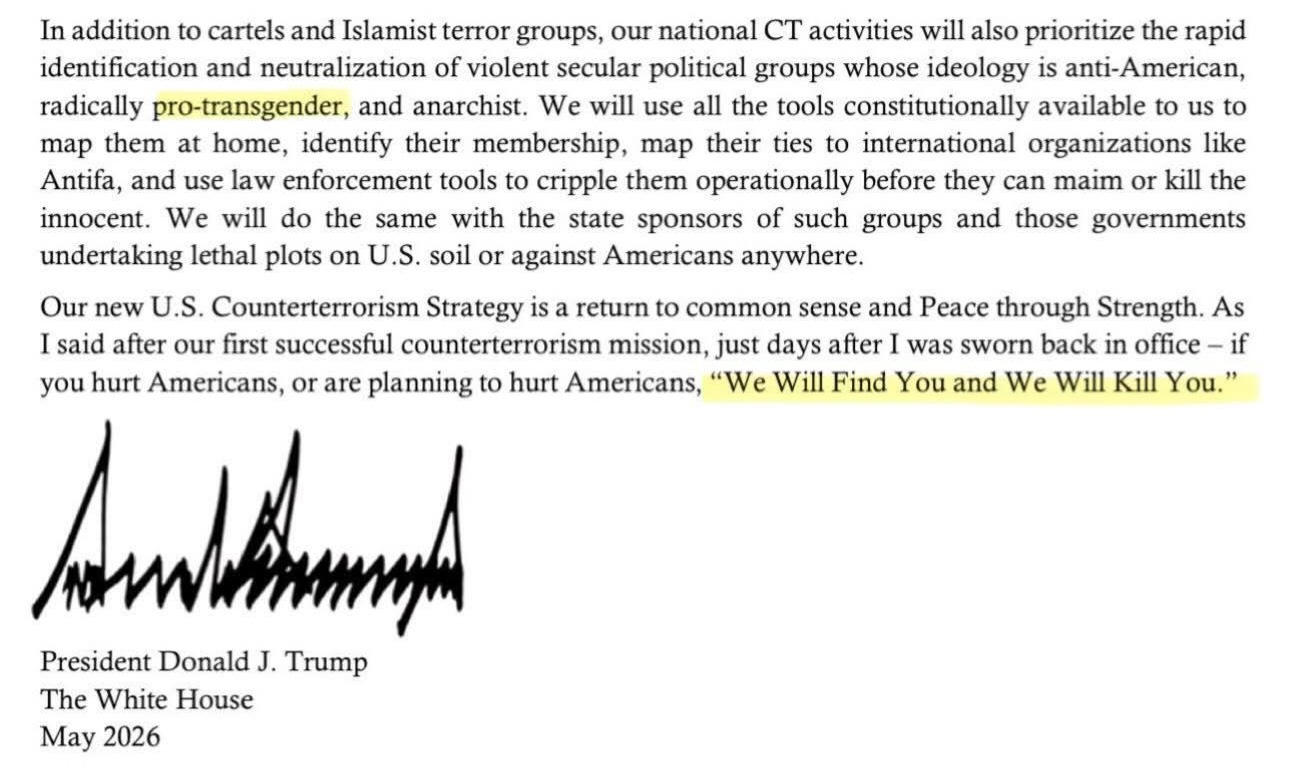
I need to tell you something about that image: it’s technically misleading. The first passage classifies “radically pro-transgender” ideology as a terrorism priority. The second is the “We Will Find You and We Will Kill You” closer. They’re not adjacent in the actual document. The kill threat appears in the Presidential Foreword, in the context of counterterrorism operations broadly. The transgender language appears pages later, in the Counterterrorism Priorities section. Whoever made that image cut and stitched them together for maximum horror.
I want to be honest about that. The image is designed to provoke, and it works by collapsing distance, making two things feel like one thing.
But they’re in the same document. And the part that actually terrifies me isn’t the kill quote.
It’s the word “map.”
What the document actually says
I read it. All of it. You should too, if you can stomach it.
The strategy lists three categories of domestic terrorism threat: narcoterrorists and transnational gangs, legacy Islamist terrorists, and “Violent Left-Wing Extremists, including Anarchists and Anti-Fascists.”
Then, in the priorities section, it gets specific. The administration will “prioritize the rapid identification and neutralization of violent secular political groups whose ideology is anti-American, radically pro-transgender, and anarchist.” They’ll use “all the tools constitutionally available” to do the following, and I’m quoting directly here:
“map them at home, identify their membership, map their ties to international organizations.”
Map them at home. Identify their membership.
I don’t know exactly what “radically pro-transgender” means to the people who wrote this. The document tries to have it both ways. It insists its counterterrorism powers “will not be used to target our fellow Americans who simply disagree with us.” Then it defines a political ideology as a terrorism priority. Maybe it’s meant to be narrow. Maybe it refers only to violent extremists who happen to hold trans-affirming views.
But I’m a transgender person. I exist. That makes me, by definition, pro-transgender. Where is the line between “radically pro-transgender” and just… trans?
I don’t know. And I suspect that ambiguity is intentional.
What I do know is what “map them at home, identify their membership” looks like in practice. We’ve been watching it happen.
We know what mapping looks like
Two weeks ago I wrote about Palantir’s Technological Republic and what it’s already doing. I want to return to that, because it’s not theoretical. If anything, this CT strategy document makes it more urgent.
In April 2025, ICE awarded Palantir a $30 million contract to build ImmigrationOS, a platform designed to identify and deport immigrants faster, pulling data from the IRS, Social Security, passport databases, and license plate readers. The operational version is an app called ELITE. Agents open it and see a map. Each person on that map has a dossier: photo, address, a “confidence score” predicting whether they’re actually there right now.
Agents draw shapes on the map to select areas of interest. The internal term for those areas is “target-rich.”
The data feeding those dossiers comes from Medicaid records, DMV files, utility bills, court records. Update your address to get healthcare, and that feeds your confidence score. The system isn’t looking for a specific individual. It’s optimized for volume. Draw a shape, query everyone inside, process the results.
This is what “map them at home, identify their membership” looks like when it runs. Not a figure of speech. Not a metaphor. A product, already deployed, already operational, already producing results measured in arrests and deportations and detention facility deaths.
The infrastructure doesn’t have opinions about who you point it at.
Palantir is already embedded in federal counterterrorism infrastructure. Its Maven AI targeting system is a permanent Pentagon budget line item, ingesting data from more than 150 sources. The company that built the tool for finding immigrants in “target-rich” neighborhoods is the same company providing AI infrastructure to the national security apparatus that just named “radically pro-transgender” groups as a counterterrorism priority.
The Palantir manifesto doesn’t contain a limiting principle. “Dysfunctional and regressive” is definitional clay. It means whoever those in power need it to mean. The infrastructure to act on it is already built. The 2026 Counterterrorism Strategy just handed the administration a new category to feed into it.
Maybe that’s not what will happen. Maybe the courts will intervene. Maybe the ambiguous language really does mean only violent actors. Maybe there are limits I can’t see.
But I can’t find the structural thing that would stop it. Can you?
Step zero: erase the documents
Before you map a population, it helps if that population can’t prove who they are.
In February, Kansas passed SB 244 and immediately invalidated the driver’s licenses of approximately 1,700 transgender residents. Not prospectively, retroactively. People woke up one morning and their ID was invalid. They received letters saying their licenses were “invalid immediately” and that they “may be subject to additional penalties” if they kept driving. Birth certificates were invalidated too.
Kansas went further than any state has before, the first to retroactively cancel IDs already legally changed. The ACLU’s Harper Seldin described what this means in practice: it “threatens to out transgender people against their will every time they apply for a job, rent an apartment, or interact with police.”
The federal government has been invalidating transgender people’s passports. So if you’re a trans person in a state like Kansas, you may have no valid state ID and no valid federal travel document.
You are, effectively, documented out of existence.
Think about what that means in the context of a government that just announced it intends to map and identify the membership of people who hold “pro-transgender ideologies.” You can’t flee without documents. You can’t prove who you are without documents. You become simultaneously more visible, flagged in databases as a person who changed a gender marker, and more invisible, stripped of the legal personhood that would let you navigate the world.
The documentation erasure and the surveillance infrastructure aren’t separate stories. They’re the same story.
How am I supposed to keep going?
I’ve lost two friends to suicide in the past year. Both trans. Another was murdered.
I’m going to sit with that for a second, because I think we move past these sentences too fast. Two people I loved decided that the weight of existing in this country as a transgender person had become unbearable. One more was killed. Three people. One year.
I understand the desperation. I want to be honest about that, not in an abstract “I empathize with those who struggle” way, but in a direct, personal way. There have been moments this past year where I’ve felt it myself. Where the legislation, the policy, the document that just named me as a mapping priority, the grief of watching friends disappear, piled up until the question of whether to keep going felt genuinely open.
Some days it feels like the only reason I’m still here because I’m too fucking stubborn to give fascists what they so clearly want.
The honest answer to “how am I supposed to keep going” is: I don’t know. I don’t know how we’re supposed to hold jobs and relationships and community while a machine is being built to find and neutralize us. I don’t know how we’re supposed to act normal when nothing about this is normal. The erosion of normalcy is part of the design. The goal, I think, is to make the weight so constant and so crushing that trans people either comply or disappear from public life.
Some people have suggested fleeing. Some of my friends already have. But many of us can’t. Identificaiton invalidated. Finances insufficient. Visas not guaranteed. They’ve thought about the exits. The documentation erasure isn’t incidental. It’s load-bearing.
So I don’t have a clean answer. What I have is this: I’m still here. I’m writing this. That’s today’s answer, and I’m not going to dress it up as more than it is.
The viral image is sensationalized. The infrastructure behind it is not.
The fear isn’t a response to edited images. It’s a response to a government that has already built the tools, named the next category, and started erasing the documents that would let us prove we exist, and to the very real, very human cost accumulating while the machinery runs.
If you’re a trans person in crisis, please reach out. Trans Lifeline is staffed by trans people, for trans people. You can call them at (877) 565-8860.